AI in 2026: The Spring of the Anti-Credentialist
For years, the loudest narrative about AI has been simple and scary: "AI is coming for your job." It's a line that writes itself -- visceral, urgent, built to travel. But the data coming out of 2026 tells a different story. What's actually happening is more interesting: AI is rewriting job structures, reshaping skill requirements, and handing the keys to technical work back to ordinary people -- no degree, no pedigree, no gatekeepers required.
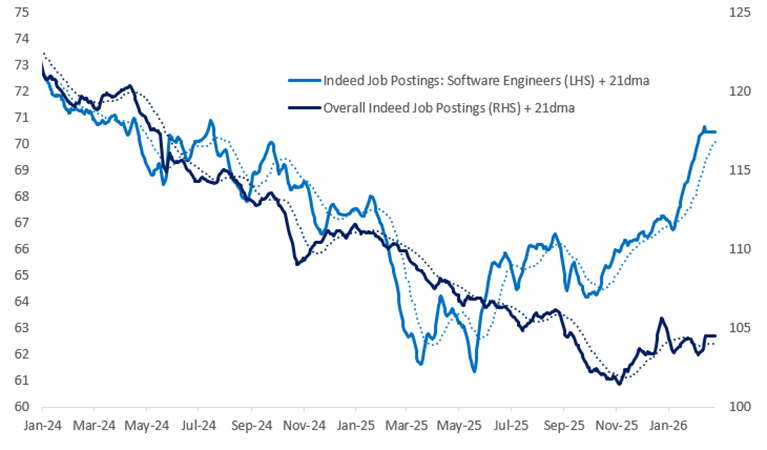
Take the United States. Citadel Securities' February 2026 report, The 2026 Global Intelligence Crisis, cuts through the noise: despite the drumbeat of "AI will imminently destroy white-collar employment," U.S. software engineering job postings are rebounding fast -- up 11% year over year. The report pulls from labor-market and AI-adoption data and lands on a clear conclusion: there is no sign whatsoever of "imminent mass displacement." What AI is actually delivering isn't a jobs vacuum -- it's productivity gains, task restructuring, and new demand that didn't exist before.
The story holds beyond the U.S., too. In China, new AI-related job postings on the hiring platform Maimai have surged 14-fold year over year, with algorithm engineers, large-model engineers, and backend developers topping the most-wanted list. During the 2026 campus recruitment cycle, the country's largest tech firms went all-in on AI: Baidu made over 4,000 offers with AI roles accounting for more than 90% of them; Alibaba extended 7,000-plus offers with AI positions exceeding 60% company-wide and hitting 80% in some divisions; ByteDance opened more than 5,000 roles with engineering headcount up 23% year over year.
The numbers converge on one point: AI isn't killing opportunity -- it's redistributing it.
This Is the Spring of the Anti-Credentialist

Let's be clear about what anti-credentialism is not. It's not anti-learning. It's not a slogan for "you don't need an education."
What it is: a commitment to first-principles thinking and a rejection of rigid social screening -- the idea that you can only be professionally useful after collecting the right degree, passing the right exam, or surviving the right multi-year qualification gauntlet. For decades, technical barriers doubled as time barriers, money barriers, and identity barriers. Breaking into software, data, automation, or product design meant years of formal training, followed by an institutional stamp of approval. AI tools are blowing that wall apart.
The real signal isn't how many AI roles a tech giant is hiring for. It's the arrival of non-traditional technologists who are shipping real work.
Here's an example that should make you reconsider everything you think you know about who gets to build software. Yang Tianrun, a finance major with virtually no coding background -- someone who, days earlier, had just figured out what a pull request even was -- picked up Claude Code and landed in the top 30 global contributors to the OpenClaw project within 72 hours. Forget the viral headline for a second. What matters is what this reveals: technical barriers that used to demand years of accumulated expertise are collapsing under the weight of AI-assisted tooling. For the first time, people can turn intent into output -- define a goal, decompose the problem, validate the results -- at a level of capability once locked behind exclusive gates.
This is why credential worship, not any particular profession, is what's truly obsolete.
The dividing line going forward isn't "do you have the right degree" or "did you pick the right major." It's "can you harness AI, make it follow your lead, and put it to work." The people who ask sharper questions, break down messy problems, validate outcomes, and iterate relentlessly will capture disproportionate leverage in the new production system. AI has raised the ceiling for ordinary people while quietly draining the moats of the traditional elite.
None of this means everyone cruises to success. Democratized access has never meant democratized outcomes. AI undeniably lowered the bar for entry -- and in doing so, it raised the stakes. When everyone has powerful tools, what sets you apart isn't knowing a specific skill. It's something deeper.
So in a world where individual capability is amplified to an almost unrecognizable degree, what actually matters?
The Human Qualities That Matter Most
Not memorization. Not process compliance. Not how well you polish a resume. The single most important quality right now is the ability to effectively harness AI.
Here's why: AI can generate answers, but it can't decide which problems are worth your time. It can write code, but it doesn't carry the consequences when that code meets reality. It can spit out a hundred options, but it can't tell you which needs are real and which are dead ends. The ability to harness AI rests on a handful of more fundamental traits:
Curiosity -- are you willing to step into territory you don't already know?
Drive -- do you turn ideas into things, or just ideas into more ideas?
Honesty -- can you admit when the model is wrong, and when you are?
Empathy -- are you building for real people, or just feeding your own ego?
AI in 2026 isn't ushering in an era of effortless wins. It's ushering in an era of personal capability liberation.
AI doesn't cancel competition -- it rewrites the rules. It doesn't destroy careers -- it reshuffles them. It doesn't push humans off the stage -- it forces every one of us to answer a new question: when credentials no longer stand in for competence, and when technical barriers get flattened by tools in a matter of months, what do you actually bring to the table?
The answer is getting harder to dodge: not the certificates you collected in the past, but whether you can use AI to turn an idea into something real today -- and from that reality, produce value other people can actually use.
That's the spring of the anti-credentialist. And it's already here.