I Uninstalled My IDE -- and Hit a 150% Productivity Surge
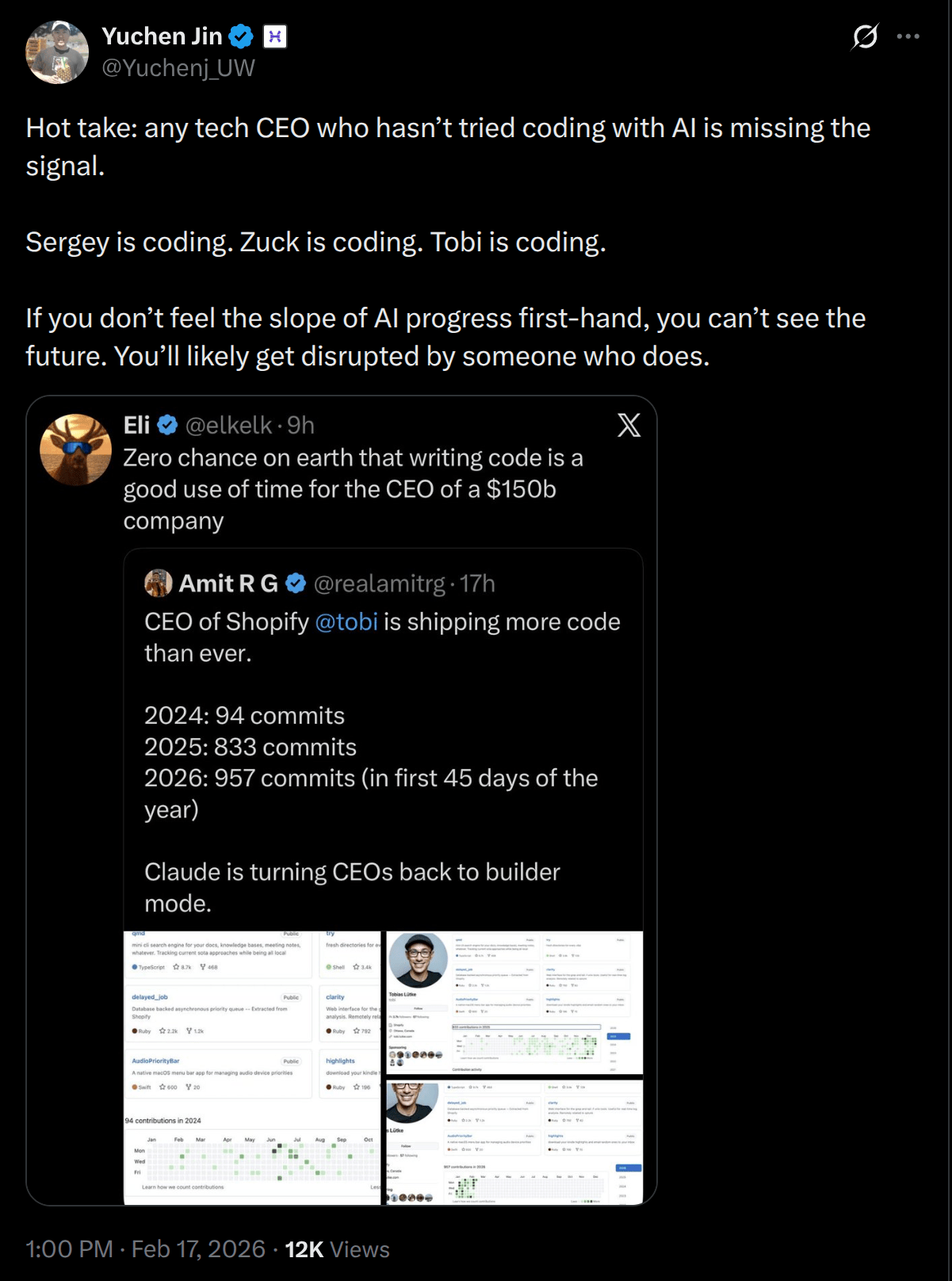
Yuchen Jin at Nvidia put it bluntly: Any tech CEO who isn't coding with AI right now is leaving money on the table. Sergey Brin is doing it. Zuck is doing it. Shopify's Tobi Lütke is doing it. If you haven't experienced how fast AI is moving firsthand, you can't see what's coming — and you'll get blindsided by those who can.
Claude Code creator Boris Cherny isn't just talking about this future. He's living it. He uninstalled his IDE. He writes 100% of his code with AI, shipping roughly 20 commits a day — without touching a single line of code himself. The result? Since Deep Code launched, per-user productivity has jumped 150%. For context, at Meta, hundreds of engineers might spend a year squeezing out a 2% gain. Here's what Boris shared on the YC podcast The Lightcone.
The software development industry is going through a tectonic shift, and Boris's conversation on The Lightcone lays out exactly where things are headed.
1. "Software Engineer" Is Becoming "Builder"
The title on your offer letter is about to change. Boris sees "software engineer" giving way to something more like "Builder" or "Product Manager."
- Productivity isn't creeping up — it's exploding. Since Claude Code launched, per-engineer output at his company has grown 150% cumulatively. At Meta, hundreds of people worked a full year to deliver 2%.
- AI owns the code. At his company, 70–90% of code is written by AI. Boris himself hasn't hand-edited a line since switching to Opus 4.5.
- The job shifts upward. The day-to-day is moving from typing out code to writing specs, designing products, and talking to users. Tomorrow's engineers need broad, cross-functional skills — not just deep technical chops.
2. Build for Six Months From Now, Not Today
Claude Code's product philosophy is simple: the model you're optimizing for today won't matter in six months. So stop over-engineering.
- Scaffolding becomes technical debt. Fine-tuning prompts and building intricate wrappers around today's model yields marginal gains at best — and the next model makes them irrelevant overnight.
- Plan Mode was just "don't write code" appended to a prompt. That's not a joke. Boris predicts that once models can plan autonomously, that feature dies. Maybe within a month.
3. Follow Latent Demand, Don't Invent It
The best AI features don't create new behaviors — they make existing ones effortless.
- Watch what users are already hacking together. CLAUDE.md wasn't some grand design. Boris saw users writing Markdown files to steer the model, so he productized it.
- Delete your config regularly. As models get smarter, they need fewer instructions. Boris recommends periodically gutting your CLAUDE.md — keep the bare essentials and let the model figure out the rest.
4. Never Bet Against the Model
The team lives by AI pioneer Rich Sutton's "Bitter Lesson."
- General-purpose computation always wins. Every time the industry has bet on hand-crafted rules over raw compute and learning, the hand-crafted approach has lost. Claude Code's philosophy is built on this.
- 80% of the codebase is less than a few months old. The team rewrites Claude Code almost continuously. Scaffolding is treated as disposable on purpose — because if a new model can do it natively, the scaffolding gets thrown out.
The Bottom Line
The frontier of model capability shifts radically every six months. The winning move is to embrace what models can do today, strip away everything else, and stay ready to unlearn and relearn on a loop. The developers who thrive will be the ones who treat AI as a native part of how they build — not a crutch bolted onto the old workflow.